Abstract
This study investigates land and property ownership in Alexandra Township and KwaMhlanga Town, two communities in South Africa where more than 60% of residents do not have title deeds to the properties they occupy. Deeds registration is crucial in protecting property owners’ rights, facilitating access to credit, and preventing disputes. The study aimed to explore residents’ perceptions of land and property ownership and assess whether the communities require a tool to help secure tenure. Qualitative research methodology was used, including nine in-depth interviews with experts and seven focus group discussions with residents. The study found that residents were concerned about securing tenure, with different practices of buying, selling, and renting land and property. The study recommends that low-cost, easy-to-use tools be developed to support local communities in ensuring tenure security. The findings highlight the urgent need for effective land registration systems to protect the rights of property owners and promote social stability and economic development.
Deeds registration is a critical process in land ownership in South Africa, and it plays an essential role in protecting the rights of property owners. Here are some reasons why deeds registration is important:
- Legal recognition: Deeds registration provides legal recognition of property ownership, ensuring that the property owner has a legal title to the property. This title provides proof of ownership and protects the owner’s rights to the property.
- Transparency: The deeds registration system provides a transparent record of all property transactions, which makes it easier to verify the ownership of a property and the history of ownership. This helps to prevent disputes over ownership and ensures that property transactions are conducted fairly and transparently.
- Protection against fraud: The deeds registration system helps to protect against fraudulent property transactions. By requiring legal documentation and verification of property ownership, the system makes it more difficult for individuals to fraudulently transfer ownership of a property.
- Securing property rights: Deeds registration is essential in securing property rights, particularly for historically disadvantaged communities. The system ensures that property rights are protected and recognized, which promotes economic development and social stability.
- Facilitating access to credit: Deeds registration provides a reliable record of property ownership, which makes it easier for property owners to access credit. This, in turn, can help to promote economic growth and development.
In conclusion, deeds registration is essential for protecting the rights of property owners, promoting transparency in property transactions, preventing fraud, securing property rights, and facilitating access to credit. Without a reliable and transparent system of deeds registration, property ownership would be much more difficult to verify, and disputes over ownership could arise, leading to instability and economic inefficiencies.
YET, more than 60% of South Africans do not have title deeds to the properties they occupy in.
This reality fuelled the commission of this research to gain a better understanding of land and property ownership in South Africa.
Executive Summary:
Rationale and Purpose for the Study
Roughly three in five (60%) South African’s land/property rights are not recorded nor registered (Advisory Panel on Land Reform and Agriculture, 2019). In 2019, the Advisory Panel on Land Reform and Agriculture recommended that the following steps be urgently taken to address this:
- Recognise a mixed tenure model that accommodates multilevel ownership on a continuum from freeholder to communal ownership.
- Promulgate legislation and related regulations to support a mix tenure model.
- Record land/property ownership especially in peri-urban and rural areas.
In August 2022, the Deeds Registries Amendment Bill was gazetted to address the hiatus and to give effect to Section 25(6)[1] of the Constitution of the Republic of South Africa (Sabinet, 2022) amongst other purposes. It also allows for recordal of land tenure rights and for promulgation of regulations for the types of documentation required. The Bill does not make any changes to the existing institution of a deeds registry which is based on a cadastral system[2] that is professionalised, complex and expensive.
Extant local literature shows that there are alternative registries that secure tenure rights, albeit on a small scale. These include those managed by tribal authorities and a few pilot projects where the formalisation of informal settlement are occurring. These are referred to as informal, community or local registers. They are often rudimentary and are not maintained. This points to the urgent need for a low cost, easy to use tools that can support local communities with strengthening their capabilities in ensuring security of tenure for their members and their engagements with authority.
The purpose of this study is to explore how residents of Alexandra township and KwaMhlanga town think about land and property with the intention to determine whether these communities need/want a tool that can assist in securing tenure and if yes, recommend design principals for such as a tool. The specific objectives of the study are to understand:
- The categories of land and property ownership and related security of tenure.
- The practices of buying, selling and renting land and property.
- The current threats to security of tenure and proof of residence.
- The documents that respondents consider important to the functioning of their everyday life.
Research Design
The study employed the naturalistic inquiry research paradigm and employed qualitative research methodology and related techniques.
Nine in-depth open-ended interviews were conducted with principals working in the field of land and property. These included academic researchers, town planners, lawyers, and land activists. The interviews were conducted telephonically and recorded digitally. Sonix was used to transcribe the recordings.
Seven focus group discussions were conducted face-to-face with residents from Alexandra township and KwaMhlanga town. Alexandra township and KwaMhlanga town were selected because of their different land administration regimes. Land and property ownership in Alexandra township is governed by common law compared to KwaMhlanga that is administered by customary law. Four focus group discussions were conducted in Alexandra township comprising residents who: 1) have title deeds, 2) have no title deeds, 3) rent, and 4) are women. Three focus group discussions were conducted in KwaMhlanga town with residents who: 1) have permission to occupy, 2) rent and 3) are women. The extra two focus group discussions with only women residents was based on local literature that showed women’s security of tenure is more precarious. All the focus group discussions were conducted in the preferred language of participants and were digitally recorded. The recordings were translated and transcribed into English. Additionally, a mini-survey was administered to all the focus group participants to obtain demographic data and access to important documentation such as identity documents, etc. The primary data-gathering was complemented with a narrow review of local and international literature on land and property tenure.
Thematic analysis was conducted on the text data and descriptive statistical analysis was applied to the mini-survey data.
Findings
The following findings emerged from the study:
- Four categories of land and property ownership
Four constructs of land and property ownership are used by focus group participants, namely:
- Individually owned: People with title deeds registered in their name. These were participants from Alexandra township.
- Permission to occupy: People who have permission to occupy the land from the chief and tribal council. These were participants from KwaMhlanga town.
- Family-house: People whose grandparents/parents had title deeds, letters to occupy, and/or permission to occupy from the chief and tribal council. These were participants from both Alexandra township and KwaMhlanga town.
- Entitled: People who are first generation occupants of municipal social housing projects. These were participants from Alexandra township.
- Family-house is an important land and property institution
The institution of family-house was central to the discussion on land and property rights. The land and property belong to the first person that moved onto it and the generations that follow; belonging to the past, present and future generations. It is a mechanism that serves as, 1) a legacy of the family name, 2) a bequest to future generations, and 3) a place for vulnerable members of their family to stay. An inadvertent outcome of this institution is that the title deeds/permission to occupy letters are still in the name of the first generation owner. While it is a valued institution, in the context of a housing crisis there appears to be growing conflict within families about rights to the family-house.
- Renters most acutely experience insecurity of tenure compared to owners
Owners feel relatively secure in their tenure because of title deeds and permissions to occupy. Nonetheless, they reported cases and threats of internal evictions from the family-house by relatives. The entitled category of owners want title deeds to allay their anxiety of eviction even though they are confident that the municipality will not dare to evict them for fear of mass protests. Renters are most insecure since they do not have rental agreements and are often desperate for a place to stay.
- Extra-legal processes are used for buying and selling land and property
The process entail the purchase and sale to be formal in that it is witnessed by a public figure who has authority like a police officer or ward councillor. The land and property transfer is not registered in the deeds registry. This process is quick and inexpensive and accommodates owners without title deeds.
- Experts propose that a land and property tenure approach should be localised that is informed by existing community practices
Experts believe a land and property tenure approach should be local and informed by existing practices for legitimacy. Moreover, such as a system should be easy to maintain and inexpensive.
- Ownership of land and property is creating a landlord class
Renters in Alexandra township believe that they are contributing to creating a landlord class. This trend was confirmed by an academic researcher based in Cape Town where landlords charge up to R5,000 for a shack in the informal settlements around the city.
- Brazen non-compliance with municipal by-laws regulating renovations and zoning in Alexandra township
Residents in Alexandra township ignore the by-laws regulating renovations and zoning. One of the outcomes is building on bulk infrastructure which makes maintenance thereof difficult. Participants in the focus group blamed this situation on an absent municipality. This was confirmed by experts, in addition they added that adhering to formal processes is expensive and requires a title deed.
- None of the participants paid for municipal services
Participants from Alexandra township have been defaulting on municipal bills that include rates and taxes, water and electricity usage and waste removal. In KwaMhlanga town residents are not expected to pay for water usage and waste removal, only for electricity consumption. They reported that they pay for electricity usage.
- Identity documents were top-of-mind of important documentation
Identity documents, followed by education certificates, record of land and property ownership, birth certificates, receipt/registration of assets, title deeds, policy documents, and will/testament are considered important documentation for everyday life.
- Participants do not struggle to get proof of residence
Generally they use letters from the chief/tribal council and local councillors as proof of residence.
These findings on the state of land and property ownership in Alexandra township and KwaMhlanga town are arranged using Elinor Ostrom’s (2005) Institutional Analysis and Development Framework in Figure A. The Institutional Analysis and Development Framework offers an elegant means of dealing with complexity such as the copious variables that intersect to structure a situation and the stakeholders involved. It also shows the relationship between the opportunities and constraints of the structure and the resulting interactions that they generate between stakeholders and the outcomes these interactions produce.
Figure A: The State of Land and Property Ownership in Alexandra Township and KwaMhlanga Town Using Ostrom’s Institutional Analysis and Development Framework
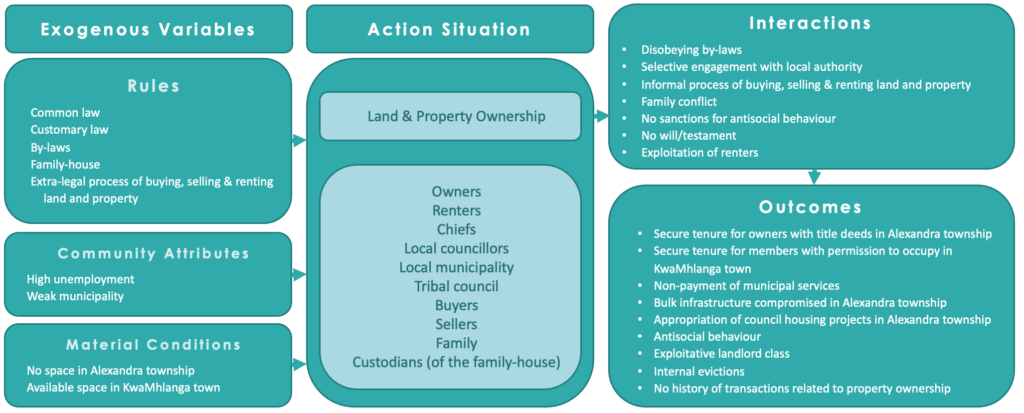
Figure A shows the multiple working norms and rules that are used to govern land and property ownership in Alexandra township and KwaMhlanga town, the salient attributes of the two places, and their material conditions. In the action arena, Figure A lists the multiple stakeholders involved in land and property ownership in the two areas mentioned by participants in the focus group discussions. The interactions between stakeholders in relation to land and property ownership, shown in the top righthand box, as a consequence of the its structure are contradictory. While there are informal processes being used these appear to be insufficient to resolve family conflict, antisocial and exploitative behaviour which, from this exploratory study, seem to be ubiquitous. Consequently, the outcomes of these interactions are secure tenure for those with title deeds in Alexandra township and permission to occupy in KwaMhlanga town. However, in the absence of recording the rights to the family-house, family conflict is rife with ongoing internal evictions. Similarly, the lack of recording land and property ownership will give rise to conflict that will destabilise the informal buying and selling process. The weak capability of the state and tribal council will continue to see perverse outcomes such as brazen disregard for by-laws and a class of exploitative landlords.
Conclusion
The findings from the study point to an urgent need for a tool that can be used by individuals and communities to record the status of family-houses, provide rental lease agreements, and log the buying and selling of property. It should be aligned to acceptable practices, the rules underpinning it should be made explicit and it should accessible to all.
Current threats to security of tenure are: 1) internal evictions from family-houses by relatives, 2) family-house ownership is in the name of the original owner and often families lose track of it, 3) extra-legal practice for buying and selling does not result in the change of ownership in the deeds registry or any other register making it difficult to maintain the history of the land and property transactions in event of conflict and arbitration, and 4) renters have no rental agreements with their landlords and feels vulnerable.
Recommendations – Design Principles
The findings from the study indicate that there is a demand for a tenure recording tool that is inclusive of the various categories of tenure, sensitive to local communities’ histories, allow diverse sources of evidence, and use digital technology.
The following design principles for a tenure recording tool emerged from the secondary and primary data collected for this study:
- Flexible: Include community and household histories, all types of evidence of tenure, multiple categories of tenure, and relationships with the land.
- Legitimate: Allow for local input in customising the tool to their contexts and needs which can be used in local arbitration and in their engagement with respective authorities.
- Responsive: Accommodate demographic changes at multiple levels – local, district, provincial and national.
- Simple: Be easy to adapt, use, maintain, store and retrieve.
- Compatible: Simply and easily adding to the cadastral system.
- Inclusive: Include intergenerational and multiple ownership.
- Accommodate: The bundle of rights and related responsibilities for living, working and playing need to be accommodated. It should also accommodate for common pool resources such as grazing land, public resources such as landfills, etc..
- Observance with the Law: Comply with the requirements of the Constitution and the processes of constitutional democracy.
- Digital Technology: Use recent digital technology such as blockchain that allows for complexity such as multilayer ownership, categories of tenure, all forms of evidences, tracking ownership, and transparent and accessible to all.